
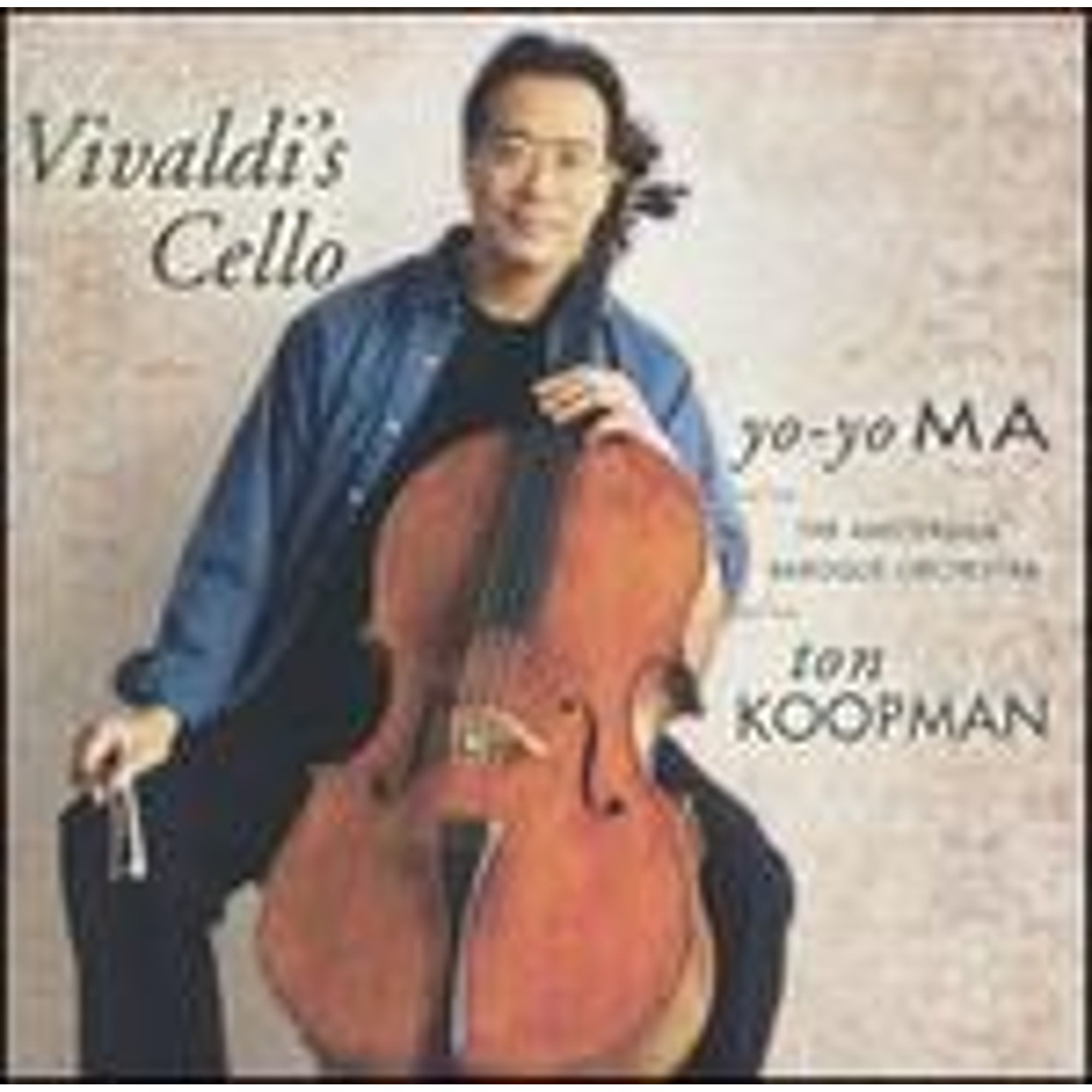
Vivaldi's Cello (CD) by Yo-Yo Ma with The Amsterdam Baroque Orchestra & Ton Koopman
Product details
| Management number | 238300055 | Release Date | 2026/07/11 | List Price | US$8.30 | Model Number | 238300055 | ||
|---|---|---|---|---|---|---|---|---|---|
| Category | |||||||||
0827969091623. New condition. CD.
Mass audiences think they know Antonio Vivaldi. Along with Mozart and Beethoven, his is a name that can be tossed out casually in association with a specific piece as a sign of knowledge of the classical repertoire. Mozart's The Marriage of Figaro, Beethoven's The Ninth Symphony and Vivaldi's The Four Seasons come to mind.
But while Mozart's and Beethoven's lives have been throughly explored and even portrayed on the big screen, Vivaldi's life remains less illuminated. Few intimate details are known about this red-haired Venetian priest who lived in the 17th and 18th Centuries and wrote much of his early work while he was maestro di violino at a girls' orphanage in Venice.
In Vivaldi's Cello, cellist Yo-Yo Ma, with The Amsterdam Baroque Orchestra and led by Ton Koopman, presents a broader picture of the composer. Together they roll out an eclectic collection of mostly shorter works, ranging from concertos to short pieces. Some were written originally for cello, others for other instruments, including voice. While some of the music will sound familiar -- yes, there's even a nod to the Four Seasons with the inclusion of the largo from "Winter" -- there is a lot of seldom played and heard material.
Ma and Koopman selected the repertoire, with Koopman arranging all the music not originally written for cello. The notion behind such arrangements (Vivaldi, after all, wrote 25 cello concertos) was to bring additional variety and color to the recording.
The contrast of timbre can be fully appreciated in the Concerto for Viola D'Amore, Lute and Orchestra, reworked as a concerto for cello, organ, strings and basso continuo. The cello's upper register, combined with the organ counterpoint, push the boundaries of the instrument and its sound. The cello also brings a new depth to the "Winter" largo, originally written for violin. But the Concerto in C Minor for Cello, Strings and Basso Continuo is, as its key indicates, a more sober, soulful experience despite its virtuosic passages.
Even for the discerning ear, it's hard to tell which pieces were originally written for the cello and which were adapted. Ma plays a Baroque cello -- configured to replicate what was played at the time -- to most closely achieve the same sound of the period. Likewise, the Amsterdam Baroque Orchestra also performs on period instruments.
Even so, it's surprising that even pieces written for soprano can so seamlessly be arranged to accommodate a new solo voice. Particularly beautiful are the joyful "Laudamus Te" from Gloria and the very lyrical, unadorned cello line in "Quanto Magis Generosa," originally written for the title character, a mezzo soprano, in the oratorio Juditha Triumphans. Similar is the gorgeous sadness of the bare and closing track, "Dite Oihm│," originally a soprano aria from La Fida Ninfa. Ma takes his listeners slowly to these places.
While Vivaldi's Cello ends on a melancholic, sparsely arranged note, it begins with Vivaldi as most people know him. The opening Concerto in G Minor for Two Cellos, Strings and Basso Continuo manages to convey the composer's passion and dramatic flare with rapid, repetitive bowing that recurs frequently in the first movement.
Yes, it's exciting. But with that lyrical finale, Ma also reminds us how beautiful it is, as well. There certainly is much more to Vivaldi than The Four Seasons.
By Leila Cobo
| Performer | Yo-Yo Ma with The Amsterdam Baroque Orchestra & Ton Koopman |
|---|---|
| Music genre | Classical, Chamber Music |
| Media format | CD |
| Has parental advisory label | N |
| Number of discs | 1 |
| Record label | Sony Music Distribution |
| Composer | Vivaldi |
| Music media format | CD |
| Is edited | N |
| Is enhanced | N |
Bestseller ranking
Mountaineering


Customers who viewed this product also viewed
Classical Composers
Correction of product information
If you notice any omissions or errors in the product information on this page, please use the correction request form below.
Correction Request Form